How Growthub’s AI team created and distributed its own product launch
A real product film, coordinated launch channels, an email-list launch and reusable work: how Growthub’s CEO and Characters helped launch Growthub.
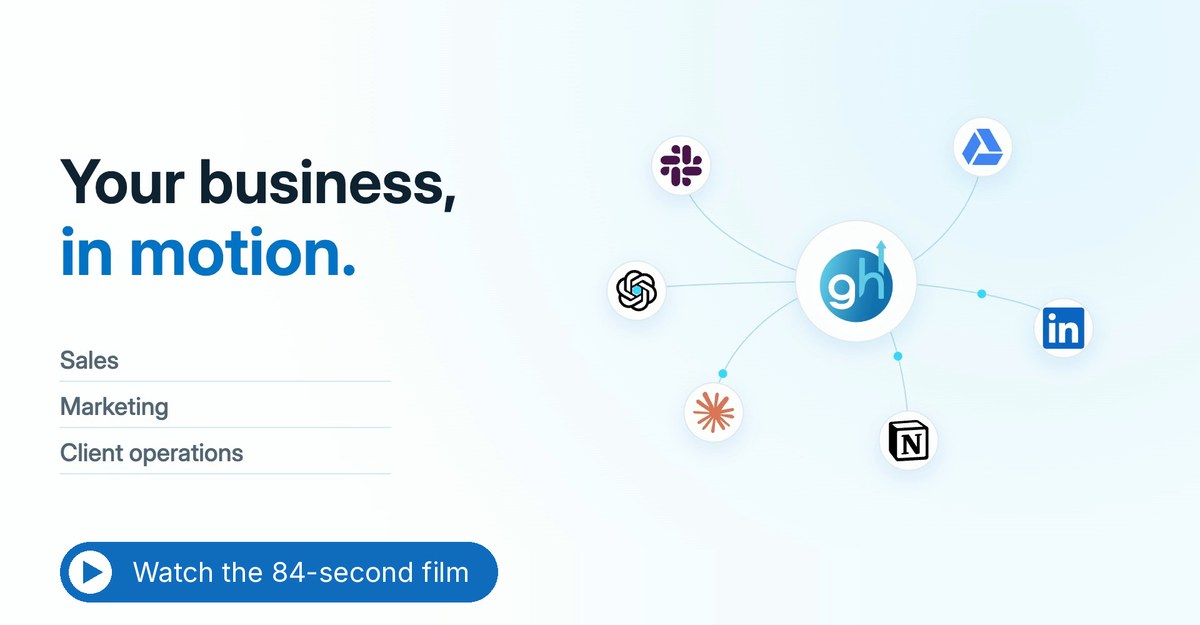
Growthub used its own AI team to turn Antonio Romero’s direction into an 84-second product film, launch articles, channel-specific social copy and real destination updates. A coordinator worked through the existing CEO and saved specialist Characters, using their native Claude or Codex providers and permitted tools. Antonio supplied the positioning, visual taste and consequential decisions; the team produced, revised, saved and checked the work.
This case study follows the launch through acquisition, activation, nurture and repeat use. The whole-product announcement had already reached Growthub’s existing eligible newsletter list and was published on Antonio’s LinkedIn and X accounts on 29 October 2026. By 2 November, the five product-launch destinations had distinct states: Product Hunt scheduled, DevHunt public free listing, Peerlist public project updated, Uneed scheduled and IdeaKiln pending. Five additional social release posts were scheduled for 3–4 November. Those later posts and the new email sequence are separate from the distribution already completed.
TL;DR
The human set the objective and corrected the creative direction; the coordinator kept the work moving across existing specialists.
The team created a narrated film, revised specific visual defects, and preserved editable sources alongside final outputs.
The release reached the existing eligible email list and published LinkedIn/X announcements; the same film and sources also support articles, social adaptations, a carousel and follow-up emails.
Public announcements, updated projects, scheduled releases and review drafts each have their own destination state.
Useful corrections became scoped methods and examples that the next assignment can reuse.
The assignment: show a business in motion
The central creative decision came from Antonio: explain Growthub through useful business execution. The early film concept followed a launch brief into a package. He rejected that framing because it narrowed a product used for sales, marketing, research and client operations to one document workflow.
The revised idea became Your business, in motion. It brought together the customer’s own Claude or Codex, saved Characters and CEO, business context, connected tools, Slack, a trusted connected iPhone and Routines. The point was what a team could accomplish with those parts connected. Connected iPhone app use is available on paid plans with a compatible Mac and the customer’s own iPhone, with confirmations where needed.
That correction changed the narration and scene structure. It also gave every downstream owner a clearer message to preserve. A social caption, directory description and article could differ in format while explaining the same product.
Watch the 84-second Growthub film. It is hosted Unlisted on Growthub’s YouTube channel and accessible through its link. The sequence introduces context and saved expertise at 0:16, Slack work and revision at 0:32, and accepted work carried into Routines at 1:01.
A coordinator connected the work; specialists owned the contributions
The campaign used Growthub’s existing team and execution setup. The coordinator translated Antonio’s objective into contributions, supplied the relevant sources, read returned findings and checked saved artifacts. It worked with the existing CEO and specialist Characters, rather than creating a second orchestration system for the launch.
Different owners handled different jobs:
Contribution | Owner’s job | Useful output |
|---|---|---|
Product film | Demo Production translated the narrative into motion, narration and media | An 84-second movie with editable sources and revision history |
Long-form content | ECHO repurposed the release into two distinct articles | A product explanation and a practical guide to reusable team methods, both saved as drafts |
Social release | Social Posting Expert adapted the message to each channel | Published whole-product announcements, followed by a separate seven-part X thread, native-film posts and follow-ups saved on the release schedule. |
Launch platforms | The existing launch owner reconciled listings and platform requirements | A new DevHunt listing, an updated Peerlist project and explicit remaining gates |
Email preparation | Newsletter Email Expert worked in its existing Claude lane | A launch sent to the existing eligible newsletter list, with a separate follow-up sequence prepared for review. Private tests are distinct from audience delivery. |
The tools followed those jobs. Film production used ElevenLabs narration and a deterministic motion/media workflow with FFmpeg. Native ChatGPT image generation supplied article artwork. Growthub Pages held working documents and results; Google Drive held movies, editable archives and review files. Browser tools handled launch-platform work. Buffer’s existing queue carried the X release, while GoHighLevel held the LinkedIn and Instagram schedules.
This division of work did not remove judgment. The coordinator still had to notice a stale source, distinguish a returned contribution from a pending one, and preserve an approved result when another part needed correction.
The film improved through focused human review
The revised narration was generated through the existing authorized ElevenLabs setup. The finished film retained a coherent visual system: white space, cool-blue hierarchy, readable typography and source-backed product examples.
Two visual corrections made the review process concrete. Enlarged screenshot strips made Slack content hard to read. The revised treatment showed the relevant request, saved result and revision component sharply, with the attachment and context intact. Elsewhere, connector curves crossed the CEO label. The fourth picture revision reserved space around that label and routed the branches below it through the animation.
That last correction was deliberately narrow. It preserved the narration, audio, captions and scene timing while making the CEO connection clearer throughout the scene. The team could improve the picture without starting the production again.
The broader lesson is practical: name the defect and preserve what already works. The team applied the same approach when independent review found an article-image header needed more clearance. The header composition changed; the article copy, original generation and accepted illustration stayed intact.
The film combines source-backed product examples. Its Slack, phone and Routine scenes should not be read as proof that every scene happened inside one uninterrupted campaign run. A film can explain a system without inventing execution history.
Saved work made the next handoff possible
A launch owner needs the right movie, not a message saying a movie exists. Social needs the current narration and approved capability boundaries. A writer needs the latest source set, not a superseded treatment.
The team saved the final movie alongside its editable source archive and kept earlier versions as history. It checked the saved destination and media identity before passing the film onward. ECHO similarly saved complete article bodies, metadata and image descriptions, then reopened the exact documents to verify the content.
This is where the growth control plane becomes useful. Projects separate work; Brand Kits supply approved identity; Pages organize methods and artifacts; Knowledge holds scoped facts and lessons. Characters reuse relevant expertise while their provider accounts and tool permissions remain explicit. The Growthub documentation explains those layers and their boundaries.
The campaign also left behind a better working method. The rejected narrow framing, the sharper Slack treatment and the CEO-label correction became reusable examples. They belonged with the relevant method and review context, rather than being pasted into every Character’s instructions.
One launch across the customer lifecycle
The same launch material serves different jobs as someone moves from discovering Growthub to using it in their business.
Acquisition: make the product discoverable
Published LinkedIn and X announcements and the existing email-list launch introduced the whole product. DevHunt’s listing and Peerlist’s updated project gave people additional places to inspect it. Product Hunt, Uneed and IdeaKiln retain their separate scheduled or pending states.
Activation: show a useful first result
The 84-second film makes the system concrete: saved expertise, business context, connected tools and a result someone can open. A first-result guide and the product articles help a reader choose a bounded job, name the sources and review what comes back. These assets support activation; they are not a claim about how many people activated.
Nurture: continue the conversation
Growthub’s existing eligible newsletter audience already received the whole-product launch. The new email sequence develops that story through a demo, a useful first result and a reusable method. Its drafts and private review tests remain separate from an audience send, with existing customer and conversation ownership preserved.
Repeat use: keep the method with the work
The film, editable files, article, social copy and email drafts share a source set, so the next format can continue from the current work. Pages keep examples and methods; Knowledge keeps supported facts; Characters point to the relevant context. When a method is useful and the owner wants it repeated, a Routine gives it an intentional schedule and scope.
Distribution meant several different destination states
On 2 November, the launch had crossed some boundaries and was waiting at others. The destination record matters more than the number of tasks marked complete.
Destination | Recorded state on 2 November 2026 | What that established |
|---|---|---|
YouTube | Final film hosted Unlisted | A shareable film link, not a publicly discoverable YouTube launch |
DevHunt | A new permanent listing was public | A live directory presence; its separate promotional slot was not live |
Peerlist | Existing project copy and media saved and reloaded | An updated project profile; the weekly launch still required verification |
Product Hunt | Final film embedded, four gallery images preserved; launch scheduled for 3 November | Saved launch preparation, not a live launch at the observation date |
X | Whole-product announcement published 29 October; separate film thread and follow-up scheduled 3–4 November | A completed public announcement and later scheduled release objects, kept separate |
LinkedIn and Instagram | LinkedIn whole-product announcement published 29 October; complete-film LinkedIn/Instagram posts scheduled 3 November and LinkedIn follow-up 4 November | An existing published LinkedIn announcement plus later platform-specific film release objects |
AlternativeTo | Account verification completed; product save rejected by the site | Preparation and a specific unresolved form error, not a submitted product |
Launching Next | Form prepared; human check and final submission remained | Prepared work awaiting completion, not a listing |
Existing newsletter list | Whole-product launch sent 29 October to the existing eligible permissioned audience | Completed email-list distribution; new follow-up drafts and private tests are separate |
Uneed | Existing submission scheduled for 12 May 2027 | Scheduled presence, not a live launch |
IdeaKiln | Existing submission pending for 2 June 2027 | Pending submission, not a live launch |
The public destinations included Growthub on DevHunt and the updated Peerlist project. The Product Hunt launch had its final film ready for the recorded schedule. These links let a reader inspect the destination; the table preserves what was known at the time of this case study. Earlier public announcements are available on Antonio’s LinkedIn and X. The email launch used the established eligible newsletter audience, rather than a new cold list.
The later film release adapts the same source to each surface. X uses a seven-part text thread linking to the film. LinkedIn uses the full native movie. Instagram uses a Reel suitable for the 84-second film. The owner approved the release slots; these objects preserve their existing copy, complete media and schedules.
Some directory work also meant choosing not to duplicate or force a result. An existing outdated listing needed reconciliation. A platform requiring a website change was excluded from that bounded assignment. Another platform’s submission stopped at an unresolved field rather than inventing an original release date. Those decisions protected the accuracy of the launch record.
A repeatable source-to-article-to-social handoff
The process can be reused without copying Growthub’s exact campaign:
Agree on the business story. Capture the human’s objective, audience and quality standard. Resolve meaningful positioning disagreements before multiplying the copy.
Choose the current source. Identify the final film, narration, product documentation and destination facts. Keep superseded versions available as history, clearly labeled.
Write one useful article. Answer a specific reader question, explain the actual work and link the evidence a public reader can inspect. Keep private operational receipts in a separate internal companion.
Adapt the accepted story by channel. Give the existing social owner the article, approved message, reusable media, factual limits and current destination states. Preserve the meaning while changing the format.
Verify each effect. Reopen the saved article, listing, post or scheduled object. Treat preparation, submission, scheduling, delivery and audience response as separate stages.
Save the lesson with its owner. Put a writing standard on the relevant method Page, a reviewed fact in Knowledge, and recurring execution in an intentionally reviewed Routine. Test whether the next assignment can actually reuse it.
The content repurposing guide and Social Posting Expert playbook provide public starting points. The same pattern applies to client launches, sales-support material, research and operational updates.
Search visibility is a next measurement, not a claimed result
This case study contributes first-party experience: the creative correction, the actual tool chain and the distinction between a live listing and a scheduled post. That editorial approach is consistent with Google’s guidance for generative AI search, which emphasizes useful, original experience and a site people can navigate. It does not guarantee crawling, indexing or appearance in an AI answer.
Bing’s AI visibility guidance describes ways to observe intent, topic and citation patterns. Citation visibility is not traffic share or proof of conversions. No search ranking, audience reach, citation lift or financial return is established by the launch record described here.
Questions about the launch
Did Growthub launch itself without human involvement?
No. Antonio set the objective, rejected the initial framing, supplied visual judgment and made consequential distribution decisions. The coordinator and existing Characters performed connected production and destination work within their available accounts, tools and permissions.
Which parts were actually distributed?
The whole-product launch had already been published on LinkedIn and X and sent to the existing eligible newsletter list on 29 October. As of 2 November, DevHunt’s permanent listing was public and Peerlist’s project updated; Product Hunt and Uneed were scheduled, IdeaKiln pending. The five film-release social posts remained scheduled for 3–4 November, while the new email sequence remained unscheduled.
Was the film the only output?
No. The campaign also produced two complete article drafts, channel-specific social copy, a separate six-card carousel for review, email preparations and reusable source and method records. Those outputs retained their own review and publication states; producing them did not automatically authorize distribution.
What should another team copy from this process?
Copy the handoff discipline: a clear human objective, existing specialist ownership, a current source set, focused revisions and verification at the destination. Keep useful methods scoped to the relevant work. The campaign is evidence of this workflow, not a promise that every app or business process can run autonomously.
Put the method to work on your next launch
Start with one outcome your team can inspect. Explore Growthub, follow the first-result guide, or use the Social Posting Expert playbook for a supported content workflow. Bring your own provider account, relevant context and a clear destination. Review the result, carry forward what works, and decide deliberately what should ship next.
About this case study
This is Growthub’s first-party account of its own campaign, based on production, email and destination records observed through 2 November 2026. It follows the work and the handoffs; it does not claim measured time savings, conversions or financial return.
Join our newsletter
Get the latest updates and insights delivered to your inbox.