The 2026 Creative OS: Find More Winning Ads with Motion’s AI Tagging
Learn how we leverage AI to streamline our entire creative workflow and automate creative structure for clients using motion analytics and their new AI tagging feature.
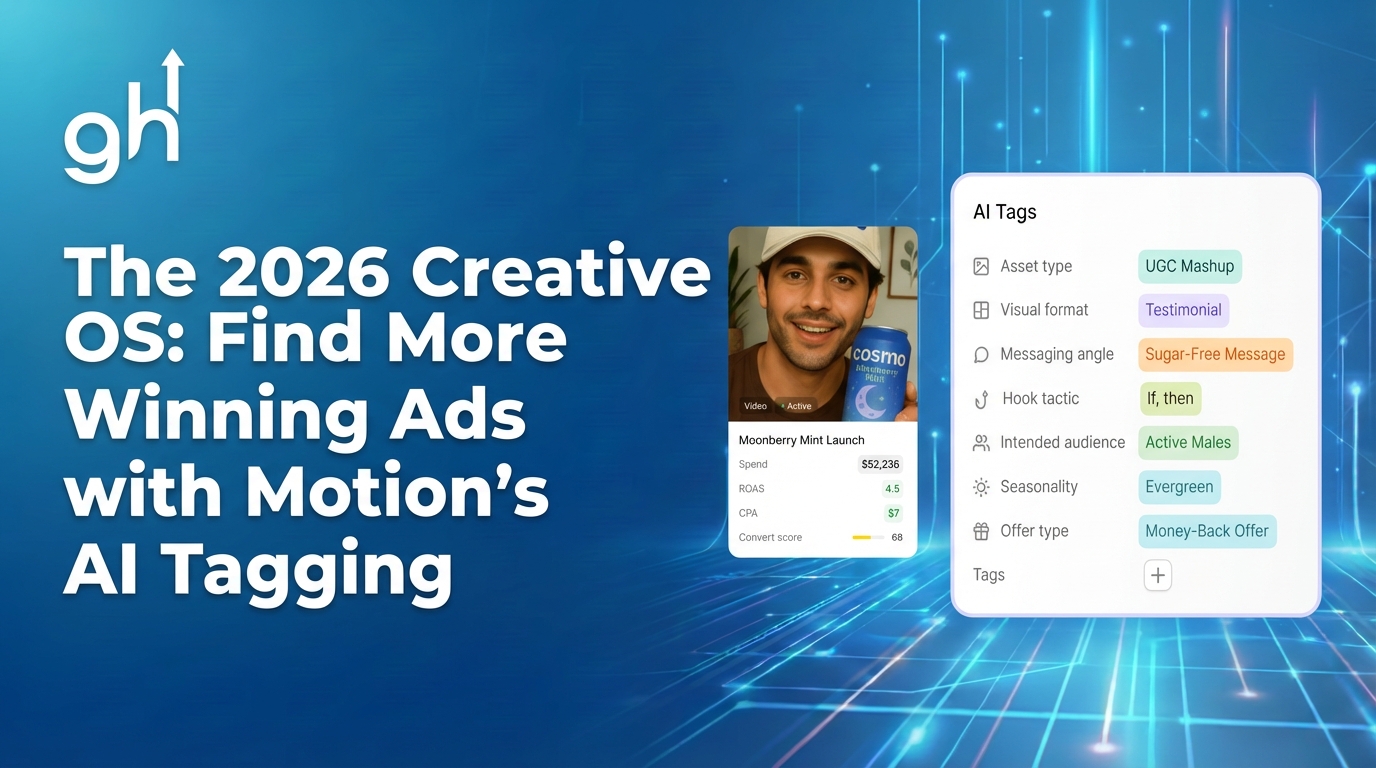
The 2026 Creative OS: Unlocking Winning Ad Patterns with Motion's AI Tagging
In the high-ticket landscape of 2026, speed isn't just an advantage; it is the baseline for survival. At Growthub, we have long championed the Creative OS, our proprietary operating system for scaling creative strategy. But even the best operating systems need hardware upgrades.
Enter the new AI Tagging feature within Motion.
For years, the bottleneck in creative testing wasn't generating ideas; it was analyzing them. Media buyers spent hours manually tagging creatives in spreadsheets. Is this a UGC video? Is the hook problem/solution? Is the angle status-seeking?
Those days are over. By integrating Motion's AI tagging into the Growthub Creative OS, we have automated the taxonomy of performance.
This post breaks down exactly how this technology works, why it matters for high-ticket operators, and how you can implement it starting today.
Part 1: The Anatomy of AI Tagging
Moving Beyond Manual Input
The core of the Creative OS relies on data integrity. If you don't know what you are testing, you cannot learn from the results.
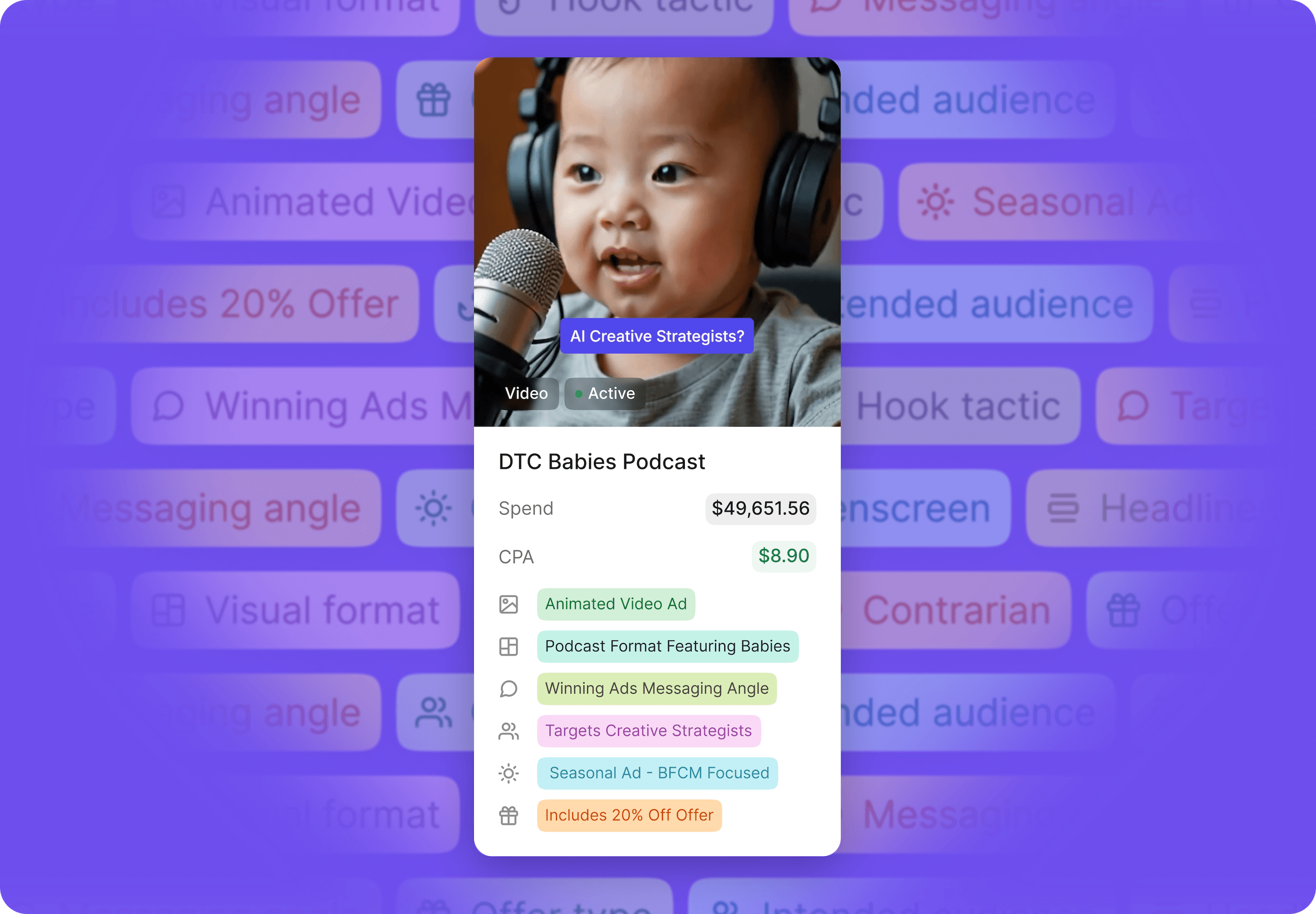
Motion's AI tagging utilizes Computer Vision and Natural Language Processing (NLP) to scan your creative assets the moment they are uploaded.
It automatically populates tags across six critical dimensions that we track across your creative ops:
1. Asset Type Instantly distinguishes between Static, Video, Carousel, or GIF. No more sorting through folders or guessing based on file names. The system knows what it's looking at.
2. Visual Format Identifies the style of the creative. This includes User Generated Content (UGC), High-Fi Production, Meme-style, Text-Overlay, and more. Format impacts scroll-stopping power, and now you can measure it at scale.
3. The Hook Analyzes the first 3 seconds to categorize the psychological trigger. Examples include "Us vs. Them," "Unboxing," "Shock Value," and "Negative Hook." The hook determines whether someone stops scrolling. This tag alone can transform your testing strategy.
4. Tactic Identifies the structural approach of the ad. Testimonial, Founder Story, Skit, Before/After, Demo. Each tactic carries different trust signals and conversion potential depending on your audience's awareness level.
5. Messaging Angle Reads the copy and audio transcript to determine the core argument. "Save Time," "Status Elevation," "Financial Freedom," "Pain Avoidance." This is where the AI reveals what your audience actually responds to, not what you think they respond to.
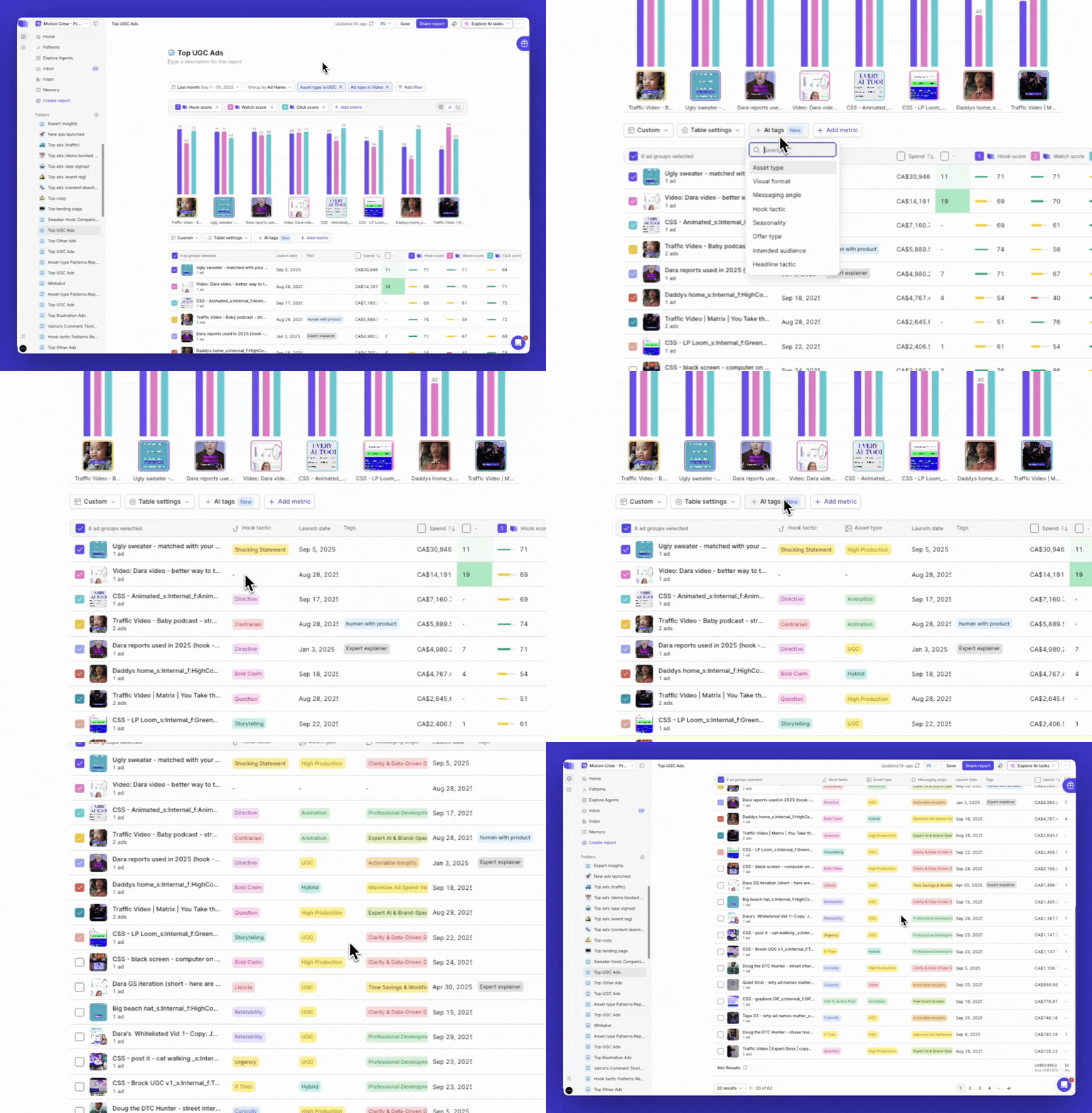
6. Offer Type Detects the call to action. Free Trial, Bundle, High-Ticket Application, Webinar Registration, Direct Purchase. Different offers convert differently at different price points. Now you can see the correlation instantly.
Why These Six Dimensions Matter
Each dimension represents a variable in your creative equation. When you test without tracking these variables, you're essentially running experiments without recording the conditions. You might find a winner, but you won't know why it won.
The Creative OS changes that. Every creative becomes a data point. Every test becomes a lesson.
Part 2: Revealing "Winning Patterns" in Seconds
Data is useless without visualization. The power of the Creative OS lies in its ability to aggregate these AI tags into actionable intelligence.
The "Pattern Recognition" Workflow
Once Motion's AI has tagged your library, our expert creative strategist trained on utilizing these AI tools, can do amazing work. Instead of looking at individual ad performance (which can be misleading due to variance and spend distribution), we look at Tag Clusters.
Here's what that looks like in practice:
Scenario: You run a coaching business selling a $15,000 program. Over the past quarter, you've tested 47 creatives across Meta and YouTube.
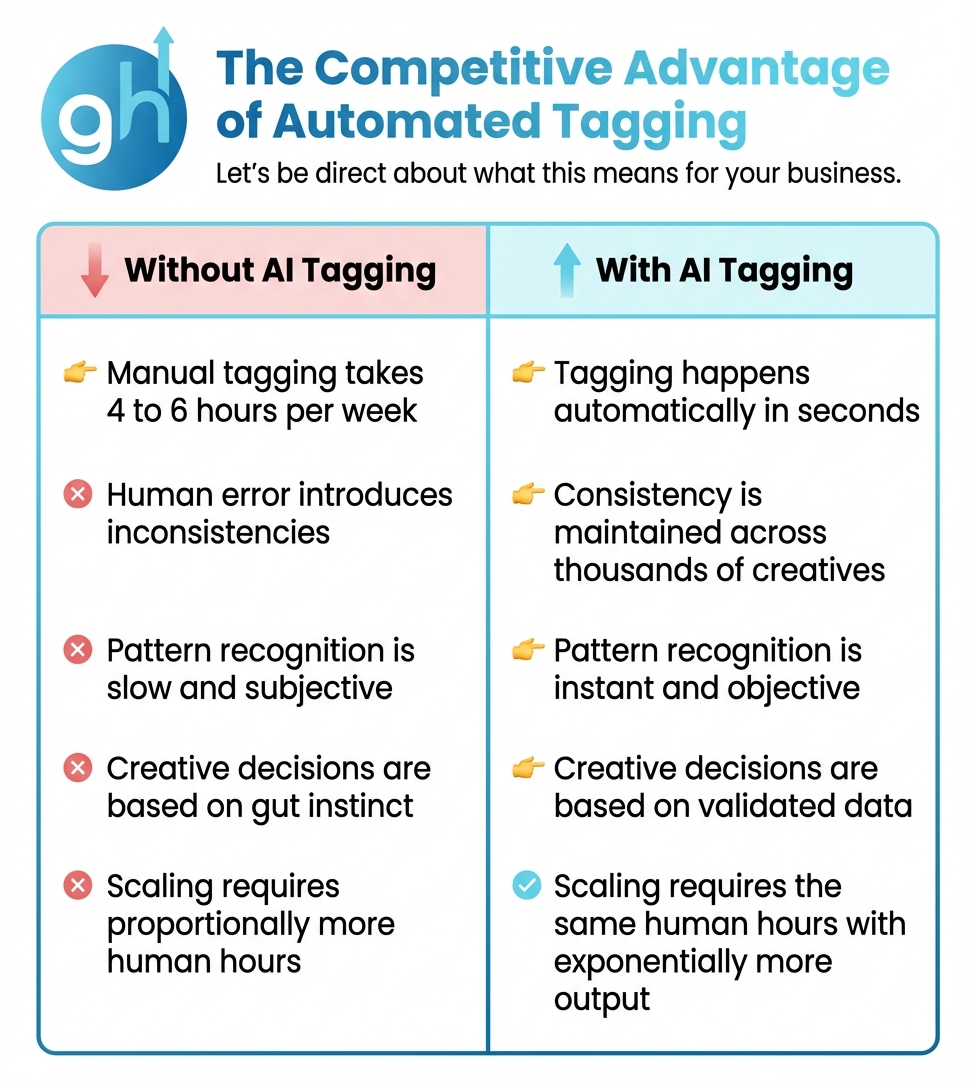
Old Method: You'd export a spreadsheet, manually tag each creative, build pivot tables, and spend 4 to 6 hours finding patterns. By the time you finished, the data was already stale.
New Method with AI Tagging: Motion tags all 47 creatives automatically.
The Insight: Your audience isn't buying for money; they are buying for impact. You didn't need to run a focus group; the AI tagging revealed this deep persona insight simply by categorizing your existing tests.
The Compound Effect of Pattern Recognition
This is where the Creative OS becomes exponential. Each sprint builds on the last. You're not starting from zero every month. You're stacking validated learnings.
By Q2, you know:
👉 Which hooks work for cold traffic vs. retargeting
👉 Which formats perform on which platforms
👉 Which angles resonate at different stages of the funnel
👉 Which offer types convert at which price points
👉 This isn't guesswork. This is systematic creative intelligence.
Part 3: Democratizing Data for Non-Media Buyers
One of the greatest friction points in agency-client relationships or internal marketing teams is the language barrier. Media buyers speak in CPA and CTR; Creatives speak in Storyboards and Vibes.
The Creative OS, powered by AI tagging, bridges this gap.
Visual Reports That Anyone Can Understand
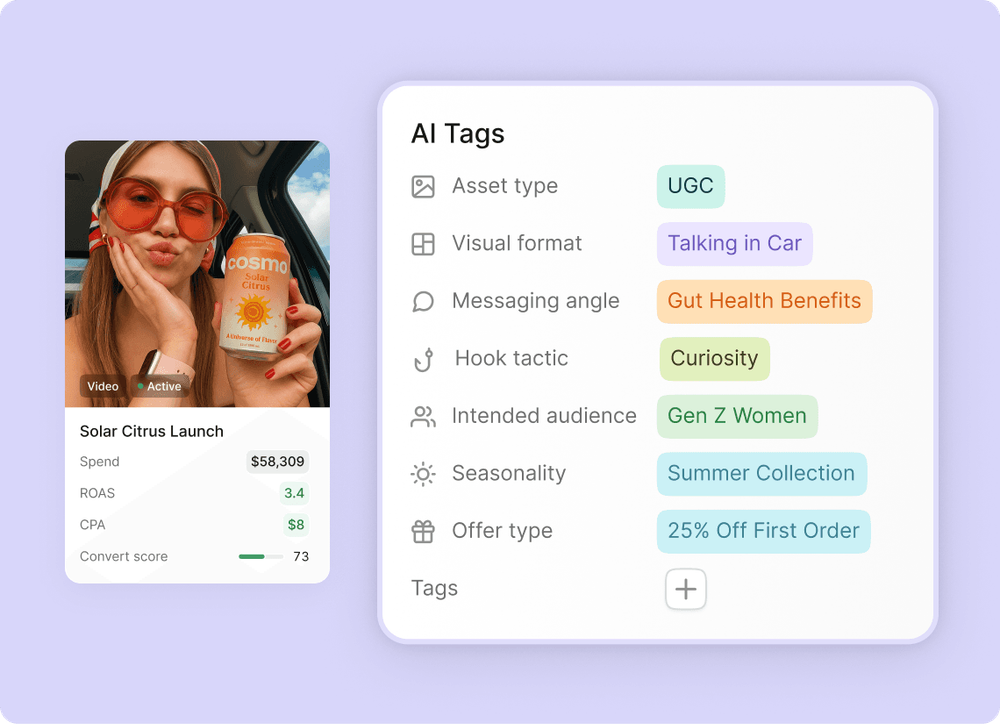
When a client asks, "What's working?" you no longer need to explain attribution windows or statistical significance. You show them the Tag Performance Report.
Example Client Report:
"Here's what we learned this month:
👉 Videos featuring real customers (UGC) outperform studio content by 40%
👉 Ads that open with a problem statement get 2x more engagement than those that open with a benefit
👉 Your audience responds strongest to messaging about saving time, not saving money
👉 The free strategy call offer converts better than the webinar funnel"
That's a conversation anyone can have. The CEO understands it. The creative director can act on it. The media buyer can optimize around it.
Empowering Creative Teams
For too long, creative teams have operated in the dark. They produce assets, hand them off, and wait for vague feedback like "that one didn't work."
With AI tagging, creatives get specific, actionable feedback:
👉 "Your last three UGC videos performed 50% above benchmark. Keep producing in that format."
👉 "Negative hooks are outperforming curiosity hooks. Lean into pain points in your opening frames."
👉 "Status-based messaging is underperforming. Shift toward impact-based angles."
This feedback loop accelerates creative development. Instead of guessing what works, teams iterate with precision.
Part 4: From Insight to Ideation (The Feedback Loop)
Insights are only valuable if they inform action. This is the "Ideation Engine" of the Creative OS.
How We Turn Data Into Briefs
Every 10 days, we run what we call the "Pattern Sprint."
Here's the process:
Step 1: Pull the Tag Performance Report Export the last 14 days of creative performance, grouped by AI tags.
Step 2: Identify the Top 3 Performing Tag Combinations Look for clusters, not individual creatives. Example: UGC + Negative Hook + Impact Angle + Application Offer
Step 3: Identify the Bottom 3 Performing Tag Combinations These are your "kill zones." Stop producing creatives with these combinations until you have new data.
Step 4: Find the Untested Combinations This is where the magic happens. Look for "Blue Ocean" tags, combinations you haven't tested yet.
Example: You have high performance on "UGC" (Format) and "Discount" (Offer). But you've never combined UGC with "High-Ticket Application" (Offer). That's your next test.
Step 5: Write the Creative Brief The brief writes itself. You're not brainstorming in a vacuum. You're prescribing specific combinations based on data.
The Brief Template
Every creative brief in the Growthub system follows this structure:
Format: UGC
Hook Type: Negative Hook
Tactic: Founder Story
Messaging Angle: Impact (Time Saved)
Offer: High-Ticket Application
Reference Creatives: [Links to top performers with similar tags]
This removes ambiguity. The creative team knows exactly what to produce. The media buyer knows exactly what to test. The client knows exactly what to expect.
Step-by-Step Implementation Guide
Here is how to utilize the Motion AI feature tagging:
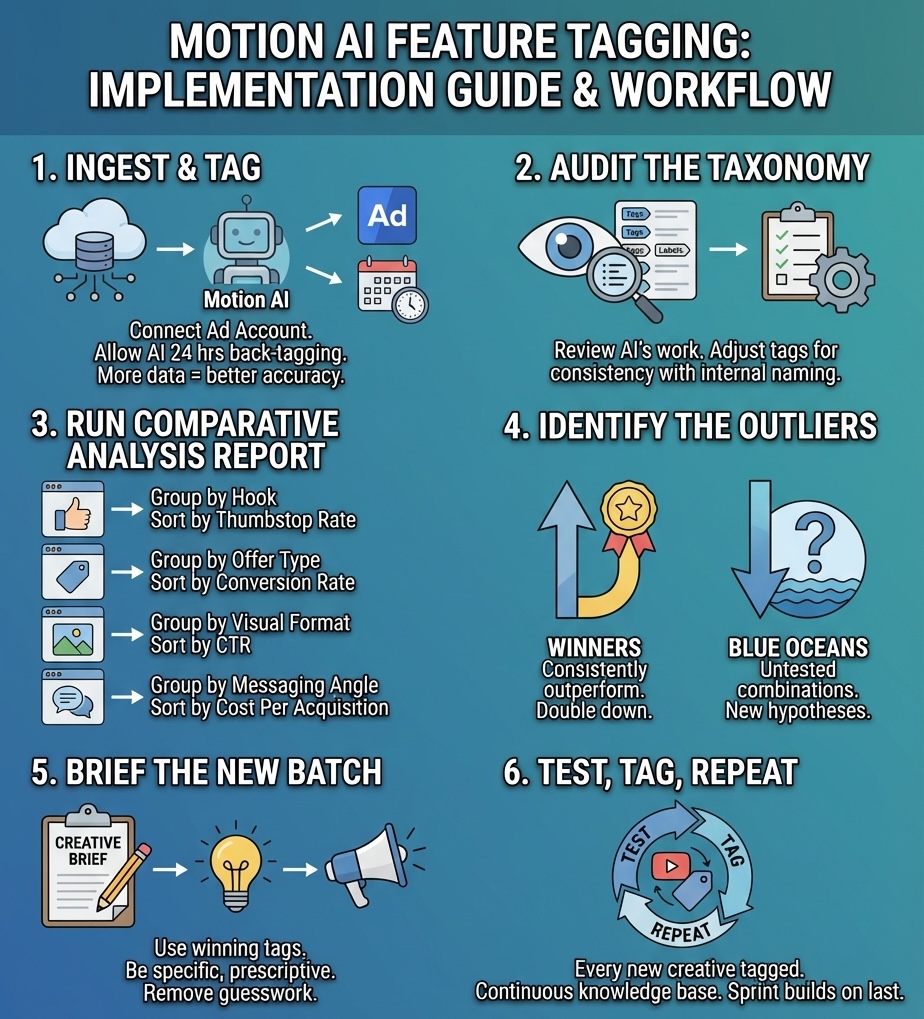
Step 1: Ingest and Tag
Connect your ad account to Motion. Allow the AI 24 hours to back-tag your historical data. The more data you feed it, the more accurate your pattern recognition becomes.
Step 2: Audit the Taxonomy
Review the AI's work. While Motion's tagging is highly accurate, you may want to adjust certain tags to match your internal naming conventions. Consistency is key.
Step 3: Run the Comparative Analysis Report
👉 This is your weekly ritual. Group and sort by different dimensions:
👉 Group by Hook. Sort by Thumbstop Rate.
👉 Group by Offer Type. Sort by Conversion Rate.
👉 Group by Visual Format. Sort by CTR.
👉 Group by Messaging Angle. Sort by Cost Per Acquisition.
Step 4: Identify the Outliers
Look for two things:
Winners: Tag combinations that consistently outperform. Double down here.
Blue Oceans: Tag combinations you haven't tested yet. These are your hypotheses for the next sprint.
Step 5: Brief the New Batch
Use the winning tags to construct the creative brief. Be specific. Be prescriptive. Remove guesswork from the creative process.
Step 6: Test, Tag, Repeat
The cycle continues. Every new creative gets tagged. Every test adds to your knowledge base. Every sprint builds on the last.
Want to Learn More?
The math is simple. Teams using AI-powered creative analysis will out-iterate, out-learn, and out-scale teams that don't.
Learn how we use Motion Analytics and our Creative OS to power millions in sales with data-driven creative workflows, AI tagging, automated reporting, and unified team operations for brands, agencies, and portfolio companies.
Conclusion: The Future of Creative Testing
The brands winning in 2026 are not the ones with the biggest budgets. They are the ones with the fastest learning loops.
Motion's AI tagging, integrated into the Growthub Creative OS, compresses weeks of analysis into seconds. It transforms creative testing from an art into a science. It gives every team member, from the CEO to the junior designer, a shared language for understanding what works.
This is not about replacing human creativity. It's about amplifying it. When you remove the manual labor of tagging and analysis, you free your team to do what humans do best: create.
The data tells you where to aim. Your team pulls the trigger.
Ready to install the Creative OS in your business? Stop testing in the dark. Let AI illuminate your winning patterns.
Contact Growthub today to scale your high-ticket offer with precision.
Published by the Growthub Content Team | Category: Creative Strategy / Ad Tech
TL;DR
Explore how the Creative OS uses Motion's AI Tagging to revolutionize ad performance in 2026. This technology automates the analysis process, empowering creative strategies and optimizing their effectiveness in high-ticket landscapes.
FAQ
What is the Creative OS?
Creative OS is Growthub's proprietary operating system designed to scale creative strategies effectively.
How does Motion's AI Tagging work?
Motion's AI Tagging uses Computer Vision and Natural Language Processing to automatically tag creative assets based on various dimensions.
Why is AI Tagging important for ads?
It automates the analysis of creative assets, saving time and providing key insights into performance without manual input.
What kind of ads can benefit from AI Tagging?
Any ads, particularly in high-ticket sales, where performance analysis and optimization are critical.
Can AI Tagging distinguish between ad types?
Yes, it automatically identifies asset types like video, static, or GIFs, enhancing sorting and analysis.
What dimensions does AI Tagging analyze?
AI Tagging analyzes asset type, visual format, hooks, tactics, messaging angle, and offer type.
How does AI Tagging improve testing strategies?
By accurately categorizing creative elements, it allows media buyers to focus on effective strategies rather than get bogged down in data entry.
Is Motion's AI Tagging user-friendly?
Yes, it's designed to streamline the creative ops process, making it easier for users to access valuable insights.
What can I implement today for better ad performance?
Integrate Motion's AI Tagging into your Creative OS to automate tagging, resulting in faster insights and improved campaign effectiveness.
Who can benefit from using the Creative OS?
Marketing teams, media buyers, and high-ticket sellers looking to enhance their creative strategies can benefit significantly.
Join our newsletter
Get the latest updates and insights delivered to your inbox.